
In dit artikel
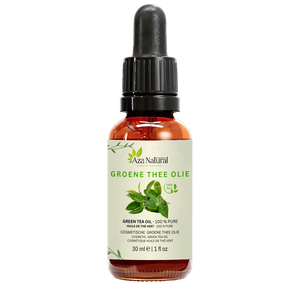
Green tea seed oil is the cold-pressed plant oil from the seeds of the tea plant, Camellia sinensis, the same shrub whose leaves are picked for green and black tea. The seeds grow in a small round capsule after the shrub has flowered, and they are a different part of the plant from the leaf. On the label of our bottle the ingredient reads Camellia Sinensis (Green Tea) Seed Oil, and there is no second ingredient. In the shop it is listed as green tea oil.
Many people arrive here after searching for 'green tea oil benefits'. This article is about something narrower: what the oil is, what the label says, how it looks and feels, and how to use it. About what the oil does in or under the skin we make no claim. The label states no figures for any component and there is no analysis of this batch, so this text contains none either. And because the name causes confusion, it also explains what green tea seed oil is not: a leaf extract, a tea, or tea tree oil.
Green tea seed oil in brief
- Ingredient: Camellia Sinensis (Green Tea) Seed Oil, exactly as printed on the label, and the only ingredient.
- Plant: the tea plant, Camellia sinensis; the oil comes from the seed, not from the leaf.
- Method: cold-pressed, as the product is listed; the label says nothing about refining.
- Colour and scent: pale yellow; a faint, slightly green scent that does not smell like tea and fades quickly.
- Texture: thin; it sinks in quickly and leaves a dry finish without shine.
- Use: the face, also in the daytime and under make-up, nails and cuticles, dry hair ends, and the oil phase of a serum or lotion; external use only.
- Sizes: 30 ml and 100 ml in dark glass, singly or in packs of three or six.
- Storage: cool, dark and closed.
Seed oil, leaf extract, matcha and tea tree: four different things
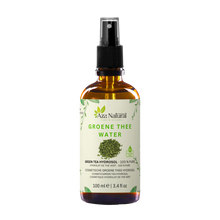
The word green tea on a bottle can mean several products, and only one of them is this oil. Green tea seed oil is pressed from the seed: a plant oil like any other seed oil, pale and thin. Green tea leaf extract is drawn from the leaf with water or alcohol and is what most cosmetics mean when they list green tea; it is not an oil. Matcha is the ground leaf itself, a powder, and green tea water is a hydrosol. The substances that green tea is known for as a drink sit in the leaf and dissolve in water; a pressed seed oil is a different product, and we do not describe this oil as a concentrated form of tea.
Tea tree oil, finally, has nothing to do with tea at all: it is an essential oil distilled from the leaves of an Australian tree, Melaleuca alternifolia, strongly scented, and never used undiluted on the skin. Green tea seed oil is a carrier oil that you can use pure.
What does green tea seed oil look, smell and feel like?
The oil is pale yellow and thin. It spreads easily, sinks in within a few minutes and leaves a dry finish: the skin does not shine afterwards, which is the reason most people choose it for the face and for the daytime. The scent is faint and slightly green, closer to a fresh leaf than to a cup of tea, and it is gone soon after applying. In the bottle it looks and behaves much like camellia seed oil, which comes from the same plant genus; the two labels name different species, and beyond that we do not compare them.
What do people use green tea seed oil for?
- On the face. Two or three drops spread over slightly damp skin; it sinks in quickly and does not shine, so it also works in the morning and under make-up.
- On nails and cuticles. One drop per hand, massaged in around the nails; a thin oil does this job better than a butter.
- In hair. A single drop through the ends of dry hair, or a larger amount as a mask that is left for twenty to thirty minutes and washed out.
- In a mixture of your own. As a large part of the oil phase of a serum or lotion, because it has little scent of its own and keeps well.
How do you use green tea seed oil on the face?
Cleanse, pat the skin dry but leave it slightly damp, and put two or three drops in your palm. Warm them between your hands and press the oil onto cheeks, forehead, nose and chin; pressing spreads a thin oil more evenly than rubbing. Within a few minutes the finish is dry. If you use a cream as well, the oil goes on first and the cream on top, or you stir a drop into the portion of cream in your hand. Under make-up, wait a few minutes before foundation. If you are new to the oil, start with one drop on the jawline and look the next day at how the skin has taken it. What the oil does to the skin beyond sinking in, we do not claim.
How do you use it on nails and in hair?
For the hands, one drop per hand is enough: put it on the back of one hand, rub the hands together and work the oil in around the nails and cuticles with the thumb. This is a use for the evening, or for any moment when the hands do not have to be dry straight away. In hair, rub one drop between the palms and smooth it through the ends of dry or towel-dried hair, staying away from the roots. For a mask, use a teaspoon to a tablespoon depending on length, work it through the lengths, leave it for twenty to thirty minutes and wash it out with a mild shampoo. Because the oil is thin, it washes out in one round.
How do you use it in a mixture of your own?
Green tea seed oil can make up a large share of the oil phase of a serum or lotion. It has little scent of its own, so it does not colour the scent of a mixture, and it keeps well, so it does not shorten the shelf life of the mixture the way a very thin fruit seed oil does. A simple face serum is two parts green tea seed oil to one part jojoba oil in a 30 ml pipette bottle. If you add an essential oil, keep it to one drop per 30 ml and do the wrist test first. Make small amounts, keep them cool and dark, and use them within a few months.
How much do you use, and which size?
Face: two or three drops per application, once or twice a day. Three drops is about 0.15 ml, so a 30 ml bottle gives two hundred applications, well over half a year at once a day. Nails: one drop per hand, a few times a week. Hair ends: one drop a day. If you use the oil only on the face and hands, 30 ml is the right size and the bottle is empty before the oil is old. If you also use it in masks or as the standing oil in your own serums and lotions, 100 ml is the better buy per millilitre. Both bottles hold the same oil.
How should green tea seed oil be stored?
Cool, dark and closed, in the dark glass it comes in, and preferably not in the bathroom. The label states no period after opening; our advice is to finish an opened bottle within a year. If the oil starts to smell sharp or old instead of faint and green, it has gone off and should not be used any more.
What to keep in mind
Green tea seed oil is for external use only. It is a cosmetic oil, so it is not for the kitchen and not meant to be swallowed; whoever wants tea seed oil for cooking buys a product labelled and sold as food. Put one drop on the inside of your wrist or elbow first and wait a day. Avoid contact with the eyes and rinse with lukewarm water if it happens. Keep out of reach of children. The label names no fragrance components; an analysis certificate of this batch is not available, so we say nothing further about that.
Where does Aza Natural's green tea seed oil come from?
We sell green tea seed oil cold-pressed and pure, with Camellia Sinensis (Green Tea) Seed Oil as the only ingredient on the label, in 30 ml and 100 ml bottles of dark glass. Other single-ingredient plant oils are in the pure oils section.