

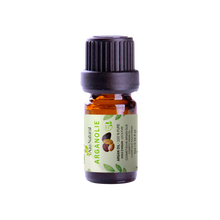

Argan oil is the cold-pressed plant oil from the kernels of the fruit of the argan tree, Argania spinosa, a thorny tree that grows on any scale only in the south-west of Morocco. On the label of our cosmetic argan oil the ingredient reads Argania spinosa (Argan) Kernel Oil, cold-pressed and made in Morocco, for hair and skin; there is no second ingredient. It is a light yellow to golden, thin oil with a mild nutty smell, sold in a 30 ml and a 100 ml bottle with a pipette and as a 5 ml sample. This page is about using it on the hair.
Many people search for 'argan oil for hair' or search for 'argan oil hair mask'. We make no claim about what this oil does to the hair, on the scalp or in the skin: the label says nothing about that, and neither do we. What you can check yourself is what the label says, how the oil feels in the hair, how much to use on the ends, in a mask and on the scalp, and how to store it. That is what this guide is about.
Argan oil for hair at a glance
- Label: Argania spinosa (Argan) Kernel Oil, the only ingredient; cold-pressed; made in Morocco; use: hair and skin.
- Cosmetic, not culinary: pressed from unroasted kernels, so light in colour and mild in smell; the kitchen oil from roasted kernels is a separate product.
- Feel: thin; absorbs into hair and skin without a greasy layer.
- Ends: one or two drops, rubbed out between the palms, on dry or damp ends.
- Mask: a teaspoon through the lengths, an hour or overnight, washed out with a mild shampoo.
- Scalp: a few drops massaged in before washing, with the mask or on its own.
- Nut oil: anyone who reacts to nuts tests first.
- Bottle and storage: 30 ml, 100 ml or a 5 ml sample; cool, dark and closed; the shop gives twenty-one months.
Cosmetic or culinary: one difference
From the kernels of the argan fruit two oils are pressed. For the culinary oil the kernels are roasted first, which gives a darker oil with a toasted, nutty smell that you put on food; for the cosmetic oil they are not roasted, which gives a lighter oil with a mild smell that goes on hair and skin. This bottle is the cosmetic one, and the roasted culinary argan oil is a separate product of 250 ml. On the hair the difference matters: the unroasted oil hardly smells once it is in the hair, where the roasted oil would smell of a kitchen.
The argan tree grows only in the south-west of Morocco, the kernels are cracked by hand and a lot of kernel goes into a little oil; that is why argan oil costs what it costs, and why one or two drops is the right amount.
How it feels in the hair
Thin and light: rubbed out between the palms and passed through the ends, it disappears into the hair without leaving it greasy, and the ends feel smoother to the touch. It is fuller than broccoli seed oil, the driest of the light hair oils, and much lighter than batana oil or castor oil, the oils for a heavy mask. Fine hair takes one drop; more than two on the ends shows as hair that looks greasy after an hour.
On the ends
Put one or two drops in the palm, rub the hands together until only a gloss is left on them, and pass the hands over the ends and the lower half of the lengths of dry or towel-dried hair, not on the roots. Comb through to spread it. This is the daily or every-other-day use, and the oil stays in until the next wash. On towel-dried hair before drying it spreads with the drying; on dry hair it is a finish. One or two drops is about 0.1 ml, so a 30 ml bottle used this way lasts most of a year.
As a mask through the lengths
Take a teaspoon, 5 ml, for medium-length hair and two for long or thick hair. Warm it between the palms and spread it through the lengths and ends of dry hair, from the ears down; massage the rest into the scalp if you like. Cover the hair with a towel or a shower cap and leave the oil for an hour, or overnight on a towel over the pillow. Wash it out with a mild shampoo; because the oil is thin, one wash is usually enough, two for thick hair. Once a week is usual. Other pre-wash masks are in the hair masks collection.
On the scalp
Spread a few drops to half a teaspoon along the partings with the fingertips or the pipette and massage for a few minutes, before washing; leave it twenty to thirty minutes, on its own or together with the mask, and wash it out. Anyone with a scalp that turns greasy quickly keeps the oil on the lengths and off the scalp. Other oils for the scalp are in the hair oils collection.
A home-made hair oil with argan oil
Argan oil has little smell of its own and keeps well, so it can be the base of a home-made hair oil: fill a 30 ml bottle with argan oil and add, if you like, a teaspoon of a heavier oil such as batana or castor for a mask that stays put, or a teaspoon of broccoli seed oil for a lighter leave-in. Add no essential oil to an oil you leave in the hair all day near the face. Mix in dark glass, label it with the date and finish it within a few months. Other base oils are in the carrier oils collection.
How much you use and which bottle to choose
Ends: one or two drops a time, so a 30 ml bottle lasts most of a year. Mask: a teaspoon a time, once a week, so six masks from 30 ml and twenty from 100 ml. Scalp: a few drops to half a teaspoon a time. On the face, two or three drops a day, and then 30 ml lasts about three months. For the ends and the face, 30 ml is enough; for weekly masks, 100 ml is the size and cheaper per millilitre. The 5 ml sample is enough to smell the oil and try it on the ends a few times. All three hold the same oil.
How to recognise a pure argan oil
By the label: one ingredient, Argania spinosa (Argan) Kernel Oil, and nothing else; a hair product with argan oil in the name often has it far down a long list. By the smell: mild and nutty, not perfumed and not toasted. By the feel: thin and quick to absorb. By the bottle: dark glass, because light ages an oil. And by the price: a lot of hand-cracked kernel goes into a little oil, and a very cheap argan oil is usually not pure.
How to store it
Cool, dark and tightly closed, not in the bathroom and not on a windowsill. Argan oil keeps better than the thin, highly unsaturated seed oils; the shop gives twenty-one months. If the oil smells sharp or old instead of mild and nutty, do not use it any more.
What to watch out for
External use only: this is the cosmetic oil for hair and skin, so do not swallow it and do not use it in the kitchen; the culinary argan oil is a different bottle. Argan oil is a nut oil: anyone who reacts to nuts tests a drop in the crook of the elbow first and waits a day, and asks a doctor when in doubt. Avoid contact with the eyes and rinse with lukewarm water. Keep out of reach of children. The label names one ingredient and no fragrance; an analysis certificate of this batch we do not have.
Frequently asked questions
How many drops of argan oil on the ends?
One for fine or short hair, two for long or thick hair, rubbed out between the palms first.
Can I leave argan oil in overnight?
Yes, as a mask: a teaspoon through the lengths, a towel over the pillow, and wash it out in the morning.
Is this the same as the argan oil for the kitchen?
No. The kitchen oil is pressed from roasted kernels and is a separate product; this one is unroasted and for hair and skin.
Which bottle should I start with?
The 5 ml sample to smell and try it, 30 ml for the ends, 100 ml for weekly masks.

