
Dans cet article
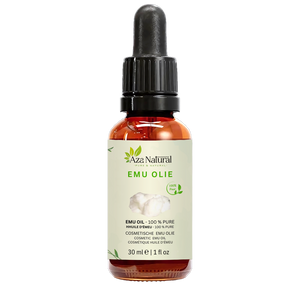
Emu oil is the rendered and filtered fat of the emu, Dromaius novaehollandiae, a large flightless bird from Australia. On the label of our emu oil the ingredient reads Dromiceius (Emu) Oil, and there is no second ingredient. It is not a plant oil and nothing is pressed: the fat is warmed until it is liquid and then filtered. The oil is pale yellow to cream-coloured, nearly scentless, and comes in a 30 ml and a 100 ml bottle with a pipette.
Many people search for 'emu oil benefits' or search for 'emu oil for skin'. We make no claim about what this oil does in or under the skin, on the scalp or to the hair: the label says nothing about that, and neither do we. What you can check yourself is what the label says, where the oil comes from and why that makes it different from every plant oil in the shop, how it looks and feels, who will not want it, and how to use it, in what amount. That is what this guide is about.
Emu oil at a glance
- Label: Dromiceius (Emu) Oil, the only ingredient.
- Origin: the fat of the emu, a flightless bird from Australia; animal, not plant.
- Colour and smell: pale yellow to cream-coloured; nearly scentless.
- Texture: rich yet quick to absorb; thicker in the cold, liquid in the hand.
- Use: very dry skin, dry patches on the body, dry scalp, hair ends, lips, after shaving, massage; external use only.
- Not for: anyone who uses no animal products; and never to be swallowed.
- Bottle and storage: 30 ml or 100 ml, dark glass with pipette; cool, dark and closed, not in the bathroom.
Where emu oil comes from
The emu is the second-largest living bird, native to Australia, and it is farmed there and elsewhere for its meat, leather and fat. The fat sits in a thick layer under the skin, mainly on the back. Emu oil is that fat, rendered, which means warmed gently until it is liquid, and then filtered and cleaned. That is the whole process; there is no seed and no press. It is the only oil of animal origin in the shop, and that is the first thing to know about it: anyone who avoids animal products will not want it, and should look at the plant oils and butters instead.
How the oil looks, smells and feels
Pale yellow to cream-coloured, and nearly scentless: open the bottle and you smell almost nothing. In a cold room it thickens and can turn cloudy or partly set, like a soft fat; in the hand or at room temperature it turns clear and liquid again, and that is not spoilage. On the skin it is rich, richer than a light seed oil, and yet it absorbs quickly without leaving a thick greasy layer. That combination, rich and quick, is what people who use it on very dry skin come back for.
On very dry skin
A thin layer after showering, on skin that is still damp, especially in winter and on the places that feel tight quickly. Half a teaspoon is enough for a pair of shins or forearms; spread it thinly and let it absorb before dressing. On the face, two or three drops each evening, pressed in with the flat of the hand; a 30 ml bottle then lasts about three months.
On dry patches
A few drops on elbows, knees, heels and hands, massaged in at night. Here the oil stays for a moment before it absorbs, and that is exactly what you want on skin that is rough to the touch. Cotton socks over oiled heels keep the oil off the sheets.
On the scalp and the hair ends
Half a teaspoon massaged into a dry scalp once a week before washing, left for half an hour and washed out with shampoo; the oil is rich, so a second shampoo may be needed. On the ends, one drop rubbed between the fingertips and smoothed over towel-dried hair; more than a drop weighs the ends down.
On the lips and after shaving
One drop, spread with a fingertip, on lips that feel rough, or on the skin straight after shaving, when it is still damp. Because the oil is nearly scentless, it does not compete with anything you put on afterwards.
As a massage oil
A tablespoon glides long enough for a back or a pair of legs and then absorbs without leaving a thick film. Because the oil is nearly scentless, a drop or two of essential oil per tablespoon can be smelt clearly; other carriers for massage, if you prefer a plant oil, are in the carrier oils collection.
How much you use and which bottle to choose
Face: two or three drops each evening, so a 30 ml bottle lasts about three months. Body: half a teaspoon after showering as often as the skin feels dry, so a 100 ml bottle is good for about forty applications. Scalp: half a teaspoon once a week before washing. For the face, the lips and the ends, 30 ml; for the body and the scalp, 100 ml. Both bottles hold the same oil, in dark glass with a pipette, and can also be ordered by three or six.
How to store it
Cool, dark and tightly closed, preferably not in the bathroom, and out of reach of children. If the oil thickens or clouds in the cold, that is normal; in the hand it turns clear and liquid again. The label gives no shelf life; finish an opened bottle within a year, and if it smells rancid instead of nearly nothing, do not use it any more.
What to watch out for
External use only; never swallow it. If your skin is sensitive, apply one drop to the inside of the wrist first and wait a day. Avoid contact with the eyes and rinse with lukewarm water. This is an oil of animal origin; anyone who uses no animal products chooses a plant oil or a butter such as shea butter instead. Other single-ingredient oils are in the pure oils collection.
Frequently asked questions
Is emu oil a plant oil?
No. It is the rendered fat of the emu, a bird; nothing is pressed. It is the only animal oil in the shop.
Why has it gone thick or cloudy?
Because it is cold. In the hand or at room temperature it turns clear and liquid again; that is not spoilage.
Does it smell?
Barely. Pale and nearly scentless, which is why it does not compete with anything you put on afterwards.
How long does a bottle last?
Two or three drops on the face each evening: about three months from 30 ml. Half a teaspoon on the body: about forty applications from 100 ml.