
Dans cet article
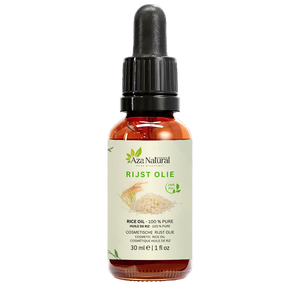
Rice bran oil is the cold-pressed plant oil from the bran of the rice grain, Oryza sativa, the grass whose grains are eaten as rice all over the world. On the label of our rice oil the ingredient reads Oryza Sativa Bran Oil, cold-pressed and made in China, as a cosmetic oil for hair and skin; there is no second ingredient. Bran is the brown skin around the grain, so the same oil is also called rice bran oil or rice germ oil in the trade. It is a light yellow, nearly scentless oil, sold in a 30 ml and a 100 ml bottle with a pipette.
Many people search for 'rice oil benefits' or search for 'rice bran oil for skin'. We make no claim about what this oil does in or under the skin or to the hair: the label says nothing about that, and neither do we. What you can check yourself is what the label says, what bran is, why this bottle is not the one from the supermarket shelf, that the oil is light and nearly scentless, and how to use it, in what amount. That is what this guide is about.
Rice bran oil at a glance
- Label: Oryza Sativa Bran Oil, the only ingredient; cold-pressed; made in China.
- Plant: rice, Oryza sativa, a grass; the oil comes from the bran, the skin around the grain.
- Colour and smell: light yellow to golden; nearly scentless, at most faintly of grain.
- Texture: thin to medium-thin; absorbs within a few minutes and leaves no greasy layer.
- Use: light face oil, massage and carrier oil for essential oils, body, hair ends; external use only, not for consumption.
- Bottle and storage: 30 ml or 100 ml, dark glass with pipette; cool, dark and closed, finish within twelve months.
What bran is
A grain of rice as it comes off the plant sits inside a hard husk. Under the husk is the bran, a thin brown layer, with the germ at one end; that is brown rice. When rice is milled white, the bran and the germ are polished off, and it is that bran, with the germ, that this oil is pressed from. That is why the label says Bran Oil and why the trade also calls it rice bran oil or rice germ oil: three names for the same oil. The label says cold-pressed and made in China; it names one ingredient and gives no shelf life.
Not the oil from the supermarket
Rice bran oil is on the supermarket shelf as an oil for the pan. That is a different product: pressed, refined, bottled and checked as food. The oil in this bottle is a cosmetic oil for hair and skin, as the label says; it is not for consumption, not for the wok or the oven and not to be swallowed. The two share a name; the label tells them apart.
How the oil looks, smells and feels
Light yellow to golden, clear, and nearly scentless: at most a faint note of grain when you open the bottle, and nothing on the skin. The texture is thin to medium-thin; it absorbs within a few minutes and leaves no greasy layer. Between jojoba oil, which is thinner, and sweet almond oil, which glides longer, it sits in the middle: light enough for the face, and with enough glide for a massage. Because it hardly smells, it lets an essential oil be smelt in a blend.
As a light face oil
Two to three drops on lightly damp, cleansed skin, in the evening or in the morning under a day cream; after a few minutes the oil has absorbed, so it works under make-up too. Once or twice a day. Three drops is about 0.15 ml, so at once a day a 30 ml bottle lasts more than six months, and at twice a day more than three.
As a massage oil and carrier oil
A tablespoon a time glides long enough for a back or a pair of legs, and because the oil is nearly scentless, a few drops of essential oil come through clearly: at most one drop of essential oil per teaspoon of carrier, so three per tablespoon. Mix the amount you need in the palm or in a small bowl; for a bottle of blend, mix in clean dark glass, label it and finish it within a few months. A tablespoon is 15 ml, so six to seven massages from 100 ml. Essential oils and other carriers are in the essential oils and carrier oils collections.
On the body
Half a teaspoon per arm or leg after showering, on skin that is still damp, for anyone who wants an oil that does not stay sticky. At daily use on the whole body a 100 ml bottle is finished in a month; that is the bottle for this use.
On the hair ends
One or two drops rubbed between the fingertips and spread over dry ends; the oil is light and does not weigh fine hair down. As a pre-wash treatment every other week, a tablespoon through the lengths, half an hour under a towel, then a shampoo; a light oil like this rinses out in one wash.
How much you use and which bottle to choose
For the face and the hair ends, 30 ml lasts for months. For massage, the body or blends, 100 ml is the size, and it is cheaper per millilitre. Both bottles hold the same oil, in dark glass with a pipette. More oil than the skin takes up stays on top of it.
How to store it
Cool, dark and tightly closed, not in the bathroom and not in the sun, and finish an opened bottle within twelve months; the label gives no shelf life and we give none either. If the oil smells sharp or rancid instead of nearly nothing, do not use it any more.
What to watch out for
External use only: this bottle is a cosmetic oil, not pressed or packed as food, so it is not for consumption, not for cooking and not to be swallowed, even though rice oil is sold as a food elsewhere. Apply one drop to the inside of the wrist first and wait a day. Avoid contact with the eyes and rinse with lukewarm water. Keep out of reach of children. Rice is not on the European list of fourteen allergens and the label names no fragrance, but there is no analysis certificate for this batch, so we promise nothing about traces. Other single-ingredient oils are in the pure oils collection.
Frequently asked questions
Is rice oil the same as rice bran oil?
Yes. Rice oil, rice bran oil and rice germ oil are names for the same oil, pressed from the bran and germ of the grain; the label says Oryza Sativa Bran Oil.
Can I use this bottle in the kitchen?
No. It is a cosmetic oil; the rice bran oil for the pan is a different product.
Does it smell?
Barely: at most a faint note of grain in the bottle, nothing on the skin. That is why it suits a blend with essential oils.
How many massages from a bottle?
A tablespoon a time: six to seven from 100 ml.