
In this article
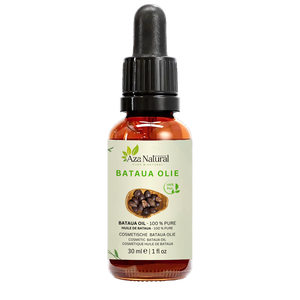
Bataua oil is the plant oil from the fruit of the bataua palm, Oenocarpus bataua, a tall palm of the Amazon basin that is also called patauá in Brazil and ungurahui in Peru. The palm carries large bunches of dark purple fruits about the size of an olive, and the oil is pressed from the pulp of that fruit, not from the seed. On the label of our bottle the ingredient reads Oenocarpus Bataua Fruit Oil, and there is no second ingredient.
Many people arrive here after searching for 'bataua oil benefits'. This article is about something narrower: what the oil is, what the label says, how it looks and feels, and how to use it. About what the oil does in or under the skin, or in the body, we make no claim. The label states no figures for any component and there is no analysis of this batch, so this text contains none either, and the oil we sell is a cosmetic oil for external use, not a food.
Bataua oil in brief
- Ingredient: Oenocarpus Bataua Fruit Oil, exactly as printed on the label, and the only ingredient.
- Plant: the bataua palm, Oenocarpus bataua; the oil comes from the pulp of the dark purple fruit.
- Other names: patauá, ungurahui, seje; our ungurahui oil carries the same ingredient line, because it is the same palm.
- Colour and scent: green-yellow to olive; a faint, slightly nutty scent that fades after applying.
- Texture: medium: thicker than a seed oil such as kiwi or pineapple, thinner than castor oil.
- Use: hair lengths and hair masks, body and hands, and the oil phase of a cream or hair oil of your own; external use only.
- Sizes: 30 ml and 100 ml in dark glass, singly or in packs of three or six.
- Storage: cool, dark and closed.
Where does bataua oil come from?
The bataua palm grows wild across the Amazon basin, in Brazil, Peru, Colombia, Ecuador and Venezuela, often in wet lowland forest and along rivers. It is a single-stemmed palm that can grow well over twenty metres tall, with fruit bunches that hang under the crown and ripen to a dark purple, almost black. In the region the fruit is used in several ways, and the oil pressed from the pulp is one of them. Where the fruit for our bottle was harvested and by whom, the label does not say, and we do not fill that in. What the label does say is the ingredient line, and that is what this article is built on.
Bataua oil, ungurahui oil and batana oil: three names, two plants
This is the point where most confusion starts. Bataua and ungurahui are two names for the same palm, Oenocarpus bataua; the first is used in Brazil and Colombia, the second in Peru. Our shop carries both a bataua oil and an ungurahui oil, and both labels read Oenocarpus Bataua Fruit Oil. Batana oil is something else: it comes from the kernel of the American oil palm, Elaeis oleifera, from Honduras, and is a clear orange oil with a mild, nutty scent that is used almost only in hair. The names differ by one letter and the plants are two different palms. If you came here looking for the Honduran hair oil, the article on batana oil is the one you want.
What does bataua oil look, smell and feel like?
The oil in the bottle is green-yellow to olive in colour, which is why it is sometimes compared to olive oil by people who see it for the first time; we make that comparison for the colour only. It is of medium thickness: it spreads easily, sinks in within a few minutes and leaves a light film that is gone after a quarter of an hour. The scent is faint and slightly nutty and does not linger. Because the oil has colour, a very light cream or balm made with a large share of bataua oil may take on a greenish tint; on the skin itself the colour does not show.
What do people use bataua oil for?
- On hair lengths. Half a teaspoon warmed between the palms and smoothed through the lengths and ends of dry hair; this is the use the oil is known for in its region.
- As a hair mask before washing. One to two tablespoons over lengths and ends, left for an hour under a towel and washed out with a mild shampoo.
- On the body and hands. About a teaspoon per arm or leg after showering, on skin that is still slightly damp, and a few drops rubbed into the hands.
- In a mixture of your own. As a large part of the oil phase of a cream, lotion or hair oil, on its own or with a thinner oil.
How do you use bataua oil in hair?
For everyday use, put half a teaspoon in your palm, rub your hands together until the oil is warm and spread thin, and smooth it through the lengths and ends of dry or towel-dried hair, staying away from the roots. Thick, dry or curly hair takes a full teaspoon; fine hair takes a few drops. For a mask, use one to two tablespoons, work it through the lengths and ends, twist the hair up under a towel or shower cap and leave it for an hour. Wash it out with a mild shampoo; lather on the dry, oiled hair first and add water afterwards, and expect to shampoo twice. Once a week is enough for a mask.
What the oil does to the hair beyond coating it, adding weight and shine until the next wash, we do not claim. If your hair feels heavy or greasy the next day, use less per application rather than less often.
How do you use bataua oil on the skin?
On the body, a teaspoon per arm or leg is enough, applied after showering while the skin is still damp; that is where a medium oil spreads best. On the hands, a few drops rubbed in around the nails. On the face it is heavier than most people want for daytime; if you use it there, take two drops in the evening on cleansed, damp skin, or mix it one to one with a thinner oil such as jojoba oil. Before the first use, put a drop on the inside of your wrist or elbow and wait a day.
How do you use bataua oil in a mixture of your own?
Bataua oil can make up a large share of the oil phase of a cream, lotion or hair oil. A simple hair oil is one part bataua oil to one part jojoba oil in a small bottle: thinner than bataua alone, and long keeping. For a body butter, melt two parts shea butter over hot water, stir in one part bataua oil, pour into a clean jar and let it set. Keep in mind that the oil has colour: a white cream with a lot of bataua oil turns slightly green. Make small amounts, keep them cool and dark, and use them within a few months.
How should bataua oil be stored?
Cool, dark and closed, in the dark glass it comes in, and preferably not in the bathroom. The label states no period after opening; our advice is to finish an opened bottle within a year. If the oil starts to smell sharp or old instead of faint and slightly nutty, it has gone off and should not be used on the skin any more. In a cold room the oil becomes thicker and cloudy; that is normal and it clears again at room temperature.
Which size should you choose?
If you use bataua oil only on hair ends or hands, 30 ml lasts for months: half a teaspoon is about 2.5 ml, so twelve applications from the small bottle, and a few drops at a time lasts far longer. If you use it for hair masks or on the body, 100 ml is the sensible size: a mask takes 15 to 30 ml, so three to six masks from 100 ml. Both bottles hold the same oil.
What to keep in mind
Bataua oil is sold here as a cosmetic oil for external use. It is not labelled as a food, so we give no advice on cooking with it or swallowing it, even though the fruit is used as food in its region; whoever wants bataua oil for the kitchen buys a product that is labelled and sold as food. Avoid contact with the eyes and rinse with lukewarm water if it happens. Do the wrist test before the first use. Keep out of reach of children, and keep the bottle cool, dark and closed. The label names no fragrance components; an analysis certificate of this batch is not available, so we say nothing further about that.
Where does Aza Natural's bataua oil come from?
We sell bataua oil with Oenocarpus Bataua Fruit Oil as the only ingredient on the label, in 30 ml and 100 ml bottles of dark glass. If you have never used it, start with 30 ml on the hair ends. Other single-ingredient plant oils are in the pure oils section, and a related Amazonian palm oil for hair with a different character is caiaué oil.