
In this article
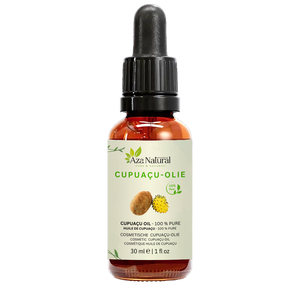
Cupuacu oil is the cold-pressed plant oil from the seeds of the cupuacu, Theobroma grandiflorum, a tree of the Amazon region of Brazil and a close relative of the cocoa tree, Theobroma cacao. On the label of our cupuacu oil the ingredient reads Theobroma Grandiflorum Seed Oil, cold-pressed and made in Brazil, as a cosmetic oil for hair and skin; there is no second ingredient. In Portuguese the name is written with a cedilla under the c; this page leaves it out, as the address of the page does. It is a light yellow to cream-coloured, full oil with a faint warm smell, sold in a 30 ml and a 100 ml bottle with a pipette.
Many people search for 'cupuacu oil benefits' or search for 'cupuacu oil for skin'. We make no claim about what this oil does in or under the skin, on the scalp or to the hair, and it is not a sunscreen: the label says nothing about any of that, and neither do we. What you can check yourself is what the label says, where the oil comes from, how it looks, smells and feels, why it thickens in the cold, and how to use it, in what amount. That is what this guide is about.
Cupuacu oil at a glance
- Label: Theobroma Grandiflorum Seed Oil, the only ingredient; cold-pressed; made in Brazil.
- Plant: the cupuacu, Theobroma grandiflorum, of the Amazon, a relative of the cocoa tree; the oil comes from the seeds inside the fruit.
- Colour and smell: light yellow to cream; a faint, warm smell with a hint of cocoa and a light fruity note, far softer than cocoa butter.
- Texture: full and slow for an oil; stays on the skin for a moment and then absorbs; thick or solid in the cold, and that is not spoilage.
- Use: dry skin on body and face, lips, hands and heels, hair ends and a home-made blend; external use only.
- Next to cocoa oil: the same kind of fat from the same family, with a much softer smell.
- Bottle and storage: 30 ml or 100 ml in dark glass with a pipette; cool, dark and closed, finish within a year.
The fruit and its relation to cocoa
Cupuacu and cocoa are two species of the same genus, Theobroma, and they resemble each other in almost everything that matters for an oil. Both grow as small trees in the shade of the South American rainforest, both carry large fruits with seeds in a pulp, and from the seeds of both a fat is pressed that is firm at room temperature in its solid form: cocoa butter from the cocoa bean, cupuacu butter from the cupuacu seed. The cupuacu fruit is large and oblong with a hard, brown, velvety shell; inside is a white, sour, strongly scented pulp that Brazilians make juice and ice cream from, and in that pulp lie dozens of seeds. From those seeds the fat is pressed, hence Seed Oil on the label.
The difference between the two sits in the fruit and in the smell. Cocoa seeds smell of chocolate after fermenting and roasting; the fat from cupuacu seeds smells only faintly, with a mere hint of cocoa. Anyone who knows cocoa butter recognises cupuacu at once by the feel on the skin, but not by the smell. More than this, that it is family and the same kind of fat, we do not claim.
How the oil looks, smells and feels
Light yellow to cream-coloured, and at room temperature liquid but clearly fuller and slower than a thin seed oil; it stays on the skin for a moment and then absorbs. The smell is faint and warm, with a hint of cocoa and a light fruity note, much softer than cocoa butter; on the skin it is largely gone after an hour. In its solid form the same fat is sold as cupuacu butter; this bottle is the form you dose with a pipette, and we do not sell the butter at present.
Why it thickens in the cold, and what to do then
Because the fat from the cupuacu seed is of the same kind as cocoa butter: liquid in a warm room, thick, cloudy or solid in a cool room or in winter. That is not spoilage. Put the closed bottle in a bowl of lukewarm water, hand-warm and no hotter, for a few minutes, or roll it between your hands; once the oil is clear and liquid again you can dose it with the pipette. Repeated setting and melting does the oil no harm, but do not warm it in a microwave or on the stove. You recognise spoilage not by the texture but by the smell: sharp, sour or rancid where the oil should smell faint and warm.
On dry skin: body and face
For both lower legs or both arms take about half a teaspoon of cupuacu oil, twenty to thirty drops from the pipette, warm it between the palms and spread it over skin that is still lightly damp, preferably straight after showering. It is fuller than a thin seed oil and glides for a moment before it absorbs; wait a few minutes before dressing. For the face two drops are enough, in the evening on cleansed skin, pressed in with flat hands rather than rubbed; in the daytime most people find it too full under make-up. The first time, try a small patch and look at the skin the next day. Other products for dry skin are in the dry skin collection.
On the lips, the hands and the heels
For the lips, one drop on a fingertip, rubbed out, as often in a day as you like; it stays on the lips longer than a thin oil and leaves no colour. It is a cosmetic oil and not made as a food, so use little and not just before a meal. For the hands, two drops per hand, massaged into the back of the hand and the cuticles, preferably in the evening. For heels and elbows, three to four drops per spot before bed, with socks over the heels; here the oil comes into its own, because it stays longer than a thin oil. Products for dry hands and heels are in the hands and heels collection.
On the hair
In dry hair, cupuacu oil goes on the ends: one or two drops warmed between the palms and passed through the lower half of the lengths, not on the scalp and not near the roots, where such a full fat quickly makes the hair heavy and greasy. Fine hair takes one drop. As a mask before washing, take about a teaspoon, spread it through the lengths and ends of dry hair, leave it half an hour to an hour and wash it out with shampoo; because the oil is full, two washes are sometimes needed. Other masks are in the hair masks collection.
In a home-made blend
In a blend, cupuacu oil is the full component that gives a body butter, lip balm or hand cream body, next to a thin oil such as jojoba or sweet almond and, for a firm balm, a little beeswax or a plant wax. Because it is liquid at room temperature you mix it cold with other oils; only with a wax or a butter do you melt everything together in a bain-marie. Start with one part cupuacu oil to two to four parts other oil and adjust by feel; more cupuacu makes the blend fuller and slower.
Add an essential oil only once the blend has cooled. A blend with water in it needs a preservative; a blend of only oils and fats does not. Write down the ratio so you can repeat it. Supplies are in the DIY collection.
Cupuacu oil, cocoa oil, mango oil and shea oil: four full oils
Anyone looking for a full body oil that thickens in the cold has four choices in our shop that differ mainly in smell. Cocoa oil is the fat of the cocoa bean in liquid form and smells clearly of cocoa; cupuacu oil is the fat of its closest relative and smells only faintly. Mango oil from the mango kernel is milder in feel, has hardly any smell and absorbs fastest of the four. Shea oil is the liquid form of the fat from the shea nut, stays longest on the skin and suits a massage and very dry patches. All four are pure, come in dark glass with a pipette, and can thicken in a cool room.
How much you use and which bottle to choose
Body: half a teaspoon of about 2.5 ml for both lower legs or both arms, so forty times from a 100 ml bottle. Face: two drops a time, about 0.1 ml, so three hundred times from 30 ml. Lips: one drop, as often as you like, which you hardly notice on the bottle. Hands: two drops per hand, so a hundred and fifty times from 30 ml. Hair ends: one or two drops; a mask a teaspoon, so twenty masks from 100 ml. For lips, hands, face or hair ends, 30 ml lasts for months; for the body, hair masks or blends, 100 ml is the size and cheaper per millilitre. Both bottles hold the same oil. More oil does not give a better result, only greasier skin and hair.
How to store it
Cool, dark and tightly closed, preferably not in the bathroom, and finish an opened bottle within a year, because the label gives no shelf life. Thick or solid in the cold is normal; if the oil smells sharp or rancid, do not use it any more.
What to watch out for
External use only: this is a cosmetic oil, so do not swallow it and do not use it in the kitchen, even though the cupuacu fruit is an ordinary food in Brazil. Apply one drop to the inside of the wrist first and wait a day; cupuacu is a relative of cocoa and not a nut in the sense of the allergen list, but what this batch contains in traces we cannot say without an analysis certificate. Avoid contact with the eyes and rinse with lukewarm water. Keep out of reach of children. This is not a sunscreen: such a product has a measured factor, and this oil has none.
Frequently asked questions
Is cupuacu oil the same as cupuacu butter?
Same fat from the same seed, in two forms: the butter is solid in a jar, the oil is liquid at room temperature and dosed with a pipette. We sell the oil.
My cupuacu oil has gone solid. Is it spoiled?
No. It has been cold. A few minutes in lukewarm water and it is clear again.
Does it smell of chocolate?
Only faintly. It has a hint of cocoa and a light fruity note, much softer than cocoa butter.
Can I use it as a sunscreen?
No. A sunscreen has a measured factor; this oil has none.