
In this article
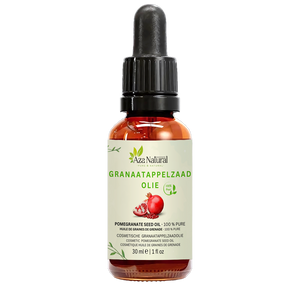
Pomegranate seed oil is the cold-pressed plant oil from the seeds of the pomegranate, Punica granatum. The pomegranate is a shrub or small tree that is native to the region from Iran to northern India and is now grown around the Mediterranean, in the Middle East and in California. On the label of our pomegranate seed oil the ingredient reads Punica Granatum Seed Oil, cold-pressed and made in Iran, as a cosmetic oil for hair and skin; there is no second ingredient. It comes in a 30 ml and a 100 ml bottle with a pipette.
Many people search for 'pomegranate seed oil benefits' or search for 'pomegranate oil for face'. We make no claim about what this oil does in or under the skin or to the hair: the label says nothing about that, and neither do we. What you can check yourself is what the label says, where the oil comes from, why it costs more than most seed oils, how it looks, smells and feels, and how to use it, in what amount. That is what this guide is about.
Pomegranate seed oil at a glance
- Label: Punica Granatum Seed Oil, the only ingredient; cold-pressed; made in Iran.
- Plant: the pomegranate, Punica granatum; the oil comes from the seeds, not from the juice or the peel.
- Colour and smell: golden yellow to light orange; faint, slightly fruity and a little nutty, gone after a few minutes.
- Texture: medium-thick; absorbs fairly quickly and leaves little shine.
- Character: a seed oil that is sensitive to air, light and warmth, and one of the more expensive ones, because the seeds give little oil.
- Use: face, home-made serum or face oil, hair mask, hands; external use only.
- Bottle and storage: 30 ml or 100 ml, dark glass with pipette; cool, dark and closed, and finish an opened bottle within a year.
Where the oil comes from
Under the leathery skin of a pomegranate sit hundreds of juicy red arils, each around a small, hard seed. The juice comes from the arils; the oil is pressed from the seeds, which is why the label says Seed Oil. A pomegranate is mostly juice and peel, and the seeds are small and hard and give little oil: it takes a great many fruits to fill one bottle, and that is the plain reason this oil costs more than sunflower or almond oil. The label says cold-pressed and made in Iran, the heart of the pomegranate's native range. It does not say refined or unrefined, and we do not add that word.
How the oil looks, smells and feels
Golden yellow to light orange in the bottle, and clear. The smell is faint, slightly fruity and a little nutty, and gone a few minutes after applying. The texture is medium-thick: thicker than jojoba oil, thinner than castor oil. It absorbs fairly quickly and leaves little shine, also under a night cream. On the hands it stays noticeable a little longer than a thin oil, which is why one drop per hand is enough.
On the face
Two to three drops on lightly damp skin after cleansing, pressed in with the flat of the hand rather than rubbed. Most people use it at night, because the oil is expensive and the evening is when nothing goes over it. If the skin still looks shiny after a quarter of an hour, that was a drop too many. Three drops is about 0.15 ml, so a 30 ml bottle lasts two hundred evenings, more than six months.
In a home-made serum or face oil
Because the oil is expensive, most people stretch it: one part pomegranate seed oil to three or four parts of a cheaper oil such as jojoba oil in a clean 30 ml pipette bottle, which means about 7 ml of pomegranate seed oil and the rest jojoba. Use three to four drops of the blend a day. A 30 ml bottle of pure oil makes four such bottles of serum, and each bottle lasts about five months at daily use. Label the bottle with the date and finish it within a few months; other carrier oils to blend with are in the carrier oils collection.
In a hair mask
Not neat, for that the oil is too expensive, but as part of a mask: half a teaspoon of pomegranate seed oil, about 2.5 ml, mixed with three teaspoons of sweet almond oil, worked through the lengths and ends of dry hair for the night and washed out in the morning with one or two shampoos. That is twelve masks from a 30 ml bottle, or forty from 100 ml. Almond is a nut on the European allergen list; anyone who reacts to nuts takes jojoba oil instead.
On the hands and cuticles
One drop per hand after washing, rubbed in down to the cuticles. The medium-thick oil stays a little longer than a thin one, so the hands feel cared for without being greasy. One drop per hand is about 0.1 ml, so three hundred applications from 30 ml.
How much you use and which bottle to choose
Used neat on the face or the hands, 30 ml lasts for months and the bottle is empty before the oil is old; for most people, and certainly for an oil this expensive, 30 ml is the right size. If you make serums or hair masks regularly, 30 ml goes in a few months and 100 ml is noticeably cheaper per millilitre; keep the large bottle cool and dark, preferably in the fridge, and finish it within a year. Both bottles hold the same oil, in dark glass with a pipette. If you do not know the oil yet, start with 30 ml. More oil does not give a better result, only a face that shines longer and a bottle that empties sooner.
How to store it
Cool, dark and tightly closed, not in the bathroom or on a windowsill, and finish an opened bottle within a year; the label gives no shelf life. The fridge is allowed and, for the large bottle, the best place. If the oil smells sharp, musty or rancid instead of faintly fruity and nutty, do not use it any more.
What to watch out for
External use only: this is a cosmetic oil, so do not swallow it and do not use it in the kitchen, even though the pomegranate itself is a fruit you eat. Apply one drop to the inside of the wrist first and wait a day. Pomegranate is not on the European list of fourteen allergens and the label names no fragrance, but there is no analysis certificate for this batch, so we promise nothing about traces; if you react, stop. Avoid contact with the eyes and rinse with lukewarm water. Keep out of reach of children. Other single-ingredient oils are in the pure oils collection.
Frequently asked questions
Is pomegranate oil the same as pomegranate seed oil?
In practice, yes: pomegranate oil, pomegranate seed oil and pomegranate kernel oil are names for the same oil, pressed from the seeds.
Why is it so expensive?
Because a pomegranate is mostly juice and peel, and the small, hard seeds give little oil.
Can I use it neat on the face?
Yes, two to three drops at night on damp skin. Most people stretch it in a blend with jojoba oil.
Is it unrefined?
The label says cold-pressed and names one ingredient; it does not use the word unrefined, and neither do we.