
In this article
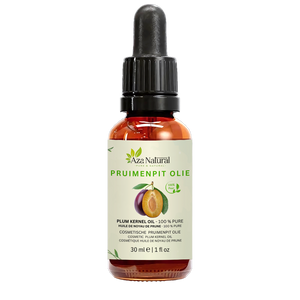
Plum kernel oil is the plant oil from the kernel of the plum, Prunus domestica, a tree of the rose family and of the same genus as the almond, the peach, the apricot and the cherry. On the label of our plum kernel oil the ingredient reads Prunus domestica (Plum) Seed Oil, and there is no second ingredient. It is a light, thin oil with a faint almond-like smell, sold in a 30 ml and a 100 ml bottle with a pipette.
Many people search for 'plum kernel oil benefits' or search for 'plum oil for face and hair'. We make no claim about what this oil does in or under the skin, on the scalp or to the hair: the label says nothing about that, and neither do we. What you can check yourself is what the label says, where the oil comes from, how it smells and feels, and how to use it, in what amount. That is what this guide is about.
Plum kernel oil at a glance
- Label: Prunus domestica (Plum) Seed Oil, the only ingredient.
- Plant: the plum, Prunus domestica, of the rose family; the oil comes from the kernel inside the stone, not from the fruit.
- Smell: faintly of almond, almost of marzipan; the smell of the kernel, and it fades on the skin.
- Texture: light and thin; absorbs quickly and leaves no greasy layer.
- Use: light face oil, also under a cream or make-up; body oil after showering; hair ends; base of a home-made face or massage oil; external use only.
- Patch test: the plum is related to the almond; anyone who reacts to almond or stone-fruit kernels tests first.
- Bottle and storage: 30 ml or 100 ml in dark glass with a pipette; cool, dark and closed.
Where the oil comes from
A plum is a stone fruit: juicy flesh around a hard stone, and inside that stone a kernel, which looks like a small almond. The oil is pressed from that kernel, not from the stone and not from the fruit; on the label the kernel is called the seed, hence Seed Oil. The kernels are what remains when plums are processed to juice, puree and dried fruit, and a great many of them go into one bottle. The label names the plant and the oil, and nothing else: no country, no shelf life, no content of anything, and so we name none of those either.
Why it smells of marzipan
The kernel of the plum resembles an almond, and you notice that in the smell: plum kernel oil smells faintly of almond, almost of marzipan, the same smell you find in bitter almond and in the kernels of apricots and cherries. It is the smell of the kernel itself, not an added fragrance; the label names none. On the skin the smell is there for the first minutes and then gone. Anyone who likes the smell of marzipan will like this oil; anyone who wants an oil that smells of nothing looks at jojoba oil instead.
How it feels
Light and thin, quick to absorb and with no greasy layer left after a few minutes; that is why it works under a cream or under make-up, and why it is a pleasant base for a home-made serum. Next to sweet almond oil, its closest relative in the shop, it feels a little lighter and absorbs sooner; next to apricot kernel oil and peach kernel oil, the other two kernel oils of the same genus, it is nearly the same in feel, and the difference is the smell: plum is the most marzipan-like of the three.
On the face
Two to three drops on cleansed, lightly damp skin, warmed between the palms and pressed in rather than spread. Because the oil is light and absorbs fast, you need little of it. In the morning it goes under a day cream or make-up: two drops, wait a minute, then the cream. In the evening it can be the last step. The first time, use one drop along the jawline and look at the skin the next day. Other oils for the face are in the face oils collection.
On the body
About a teaspoon per arm or leg, on skin that is still damp after showering; the oil absorbs fast, and you can dress within minutes. It also works on dry patches such as elbows, knees and heels, two to three drops per spot in the evening. For a massage it glides for a shorter time than sweet almond oil and then absorbs; for a long massage, mix it half and half with almond oil.
On the hair
Rub one or two drops between the fingertips and spread them over the ends of towel-dried or dry hair, not on the roots. As a hair mask you can use more, a teaspoon through the lengths; leave it twenty to thirty minutes and wash it out with a mild shampoo. Because the oil is thin, one wash is usually enough. Other oils for the hair are in the hair oils collection.
As the base of a home-made face or massage oil
Plum kernel oil is thin, has a pleasant smell of its own and absorbs fast, which makes it a good base for a home-made face oil: fill a 30 ml bottle with it and add, if you like, a few drops of a heavier or more expensive oil for the feel. For a massage oil, mix it half and half with sweet almond oil, which glides longer. If you add an essential oil, keep to at most two to three drops per tablespoon, and none in an oil you use around the eyes. Mix in clean dark glass, label it with the date and finish it within a few months. Other base oils are in the carrier oils collection.
How much you use and which bottle to choose
Face: two to three drops once a day; three drops is about 0.15 ml, so a 30 ml bottle lasts two hundred applications, more than six months. Body: a teaspoon of 5 ml per arm or leg, so twenty arms or legs from 100 ml. Hair ends: one or two drops, which you hardly notice on the bottle; a mask a teaspoon, so twenty masks from 100 ml. For the face and the hair ends, 30 ml lasts for months; for the body, massage and blends, 100 ml is the size and cheaper per millilitre. Both bottles hold the same oil, in dark glass with a pipette. More oil than the skin takes up stays on top of it.
How to store it
Cool, dark and tightly closed, preferably in the original bottle and not in the bathroom or on a windowsill; light and warmth make an oil go rancid sooner. The label gives no shelf life; finish an opened bottle within a year. If the oil smells sharp or rancid instead of faintly of marzipan, do not use it any more.
What to watch out for
External use only: this is a cosmetic oil, so do not swallow it and do not use it in the kitchen; the kernels of the stone fruits of this genus are not for swallowing either, and this oil was not pressed or checked as a food. The plum belongs to the same plant family as the almond, the peach and the apricot: anyone who reacts to almond or to stone-fruit kernels tests first on a small patch of skin and asks a doctor when in doubt; the plum itself is not on the European list of fourteen allergens, but that is not a promise.
Apply one drop to the inside of the wrist first and wait a day. Avoid contact with the eyes and rinse with lukewarm water. Keep out of reach of children. Other single-ingredient oils are in the pure oils collection.
Frequently asked questions
Why does plum kernel oil smell of almond?
Because the kernel inside the plum stone resembles an almond and smells like one. It is the smell of the kernel, not an added fragrance.
Is it the same as plum oil?
In practice yes: the flesh of a plum gives no oil, so what is sold as plum oil is the oil from the kernel.
Can I use it under make-up?
Yes. Two drops, a minute to absorb, then foundation. It is light and leaves no greasy layer.
Can I swallow it?
No. It is a cosmetic oil for skin and hair, not a food.