


Amla oil is the hair oil based on amla, the Indian gooseberry, Phyllanthus emblica, also called Emblica officinalis: a small, round, pale green and very sour fruit of a tree from India. In the Indian hair tradition amla belongs with shikakai, reetha and bhringraj to the fixed names, and amla oil is traditionally made there by steeping the fruit in a base oil. On the label of our bottle the ingredient reads Phyllanthus Emblica Fruit Extract, made in India, as a cosmetic amla oil for hair and skin. The label names no base oil and no second ingredient.
Many people arrive here after searching for 'amla oil benefits'. This article is about something narrower: what the oil is, what the label says and what it does not say, how the oil looks and smells, and how to use it. About what the oil does to the hair, the scalp or the body we make no claim. The label states no figures for any component and there is no analysis of this batch, so this text contains none either. What the Indian tradition attributes to amla, we leave with that tradition.
Amla oil in brief
- Ingredient: Phyllanthus Emblica Fruit Extract, exactly as printed on the label; the only ingredient, and no base oil named.
- Plant: amla or Indian gooseberry, Phyllanthus emblica; a small, sour, pale green fruit of a tree from India.
- Origin: made in India, as the label states.
- Colour and scent: dark; spicy and earthy, and the scent lingers for a while after a mask.
- Texture: full; it sinks in slowly and leaves a light film on the hair.
- Take care: it can stain light textiles and give light hair a warm tint; do a strand test first.
- Use: hair mask on scalp and lengths, the scalp on its own, and dry hair ends; external use only.
- Sizes and storage: 30 ml and 100 ml in dark glass with a pipette; cool, dark and closed, and finish an opened bottle within a year.
What the label says, and what we do not know
The ingredient line on this amla oil reads Phyllanthus Emblica Fruit Extract: an extract of the amla fruit, not a Fruit Oil or a Seed Oil. That is not a mistake on our part but a consequence of what amla is: the fruit is juicy and sour and yields no pressed oil the way a nut or a kernel does. In the Indian tradition an amla oil is made by steeping the dried or fresh fruit in a base oil, usually sesame or coconut oil.
This label names no base oil, and the same label also prints the words cold-pressed and pure. How this extract was made and what it sits in, we cannot tell from the label, and we do not fill that in ourselves; we have asked the supplier and will update the product page when the answer comes. Until then: anyone who reacts to sesame, coconut or nuts should not use this oil without asking first, and everyone does the wrist test.
What does amla oil look, smell and feel like?
The oil is dark and full. It sinks in slowly and leaves a light film on the hair, which is what people expect from a hair oil that goes on before washing. It smells spicy and earthy, more like a herb than like a fruit, and that scent stays in the hair for a while after a mask; after washing it is largely gone. Because the oil is dark it can stain: an old towel, a pillowcase, a light collar, and those marks do not always wash out. On light hair it can leave a warm tint, so anyone with blonde, grey or bleached hair does a strand test before using it on the whole head.
What do people use amla oil for?
- As a hair mask before washing. One to two tablespoons over scalp and lengths, left for half an hour to an hour or overnight, then washed out; this is the most chosen use.
- On the scalp. A teaspoon, spread along the partings with the fingertips and massaged in, left for half an hour and washed out.
- On the hair ends. One drop rubbed between the palms and smoothed over the dry ends, not on the roots and not more than one drop.
- Next to amla powder. Whoever already uses the powder and finds the paste too much work takes the oil: it goes on directly and can stay in overnight.
How do you use amla oil as a hair mask?
Spread one to two tablespoons of amla oil, 15 to 30 ml, over dry or towel-dried hair: start at the scalp, spread the oil along the partings with the fingertips and massage it in, then smooth the rest over the lengths with most attention for the ends. Put the hair up and cover it with an old towel or a shower cap. Leave the mask for half an hour to an hour, or overnight on an old pillowcase. Wash it out with shampoo; with a full oil, lathering twice is normal, and rinse for a long time. Longer does not give a better result, only more oil to wash out. Once a week is enough.
How do you use amla oil on the scalp and on the ends?
For the scalp alone a teaspoon is enough, about 5 ml: put a few drops on the fingertips and spread them in small circles over the scalp, parting by parting, until the whole scalp has had its turn. Leave the oil for half an hour and wash the hair as usual, lathering twice. Once or twice a week is enough; more often makes the hair heavy and costs more shampoo than it is worth. For the ends, amla oil is a one-drop oil: rub the drop between the palms and smooth them over the dry ends, from the ears down and not on the roots. Long, thick hair takes two drops, not more.
Amla oil and light hair or light textiles: the strand test
Take a few hairs from your brush, or a small strand at the nape, and rub a drop of amla oil into them. Leave it as long as you plan to leave a mask, wash it out and look at the colour in daylight. If the strand has taken on a warm tint that you do not want, use the oil only on the lengths of darker hair, or not at all. For textiles the rule is simpler: use an old towel and an old pillowcase, and put a towel over the shoulders while applying. On the skin the oil does not leave a lasting colour.
Amla oil, castor oil and sesame oil: three hair oils side by side
Anyone looking for a hair oil often ends up with one of these three. Castor oil is the thickest, viscous and almost scentless, used mainly on the scalp and the eyebrows, and hard to wash out. Sesame oil is thin, pale yellow and mild, in India the classic base oil for hair masks and the oil in which amla is traditionally steeped; anyone who reacts to sesame skips it.
Amla oil sits between them: fuller than sesame, much thinner than castor, dark in colour and spicy in scent, and the only one of the three that can stain and tint light hair. For a mask on long hair you can mix amla oil with sesame oil to make it thinner and cheaper; for the scalp alone you can use it pure. All three are washed out with two rounds of shampoo.
Amla oil and amla powder: what is the difference?
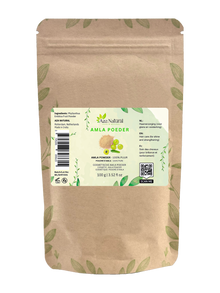
Both come from the same fruit, in a different form. Amla powder is the dried, ground fruit, on its label Phyllanthus Emblica Fruit Powder, which you mix with water to a paste, leave on the hair for half an hour and rinse out. The oil goes on the hair directly and can stay in overnight. In an Indian hair routine the two are used on different days: the oil as a mask before washing, the powder or bhringraj powder as a paste on another day. Which one suits you depends on how much time you want to spend; the powder is more work and rinses out cleaner, the oil is quicker and leaves a film.
How much do you use, and which size?
A mask over scalp and lengths takes one to two tablespoons, 15 to 30 ml, so three to six masks from a 100 ml bottle and one or two from 30 ml. The scalp alone takes a teaspoon, about 5 ml, so six applications from 30 ml and twenty from 100 ml. The ends take one drop, about 0.05 ml, so a 30 ml bottle lasts longer than the oil keeps. If you use amla oil only on the ends or want to try it first, choose 30 ml; if you use it for masks, 100 ml is the sensible size and the better buy per millilitre. Both bottles hold the same oil.
What to keep in mind
Amla oil is a cosmetic hair oil for external use only; it is not meant to be swallowed, and it is not a food. Put one drop on the inside of your wrist first and wait a day, and do the strand test if your hair is light. Because the label names no base oil, anyone who reacts to sesame, coconut or nuts asks first. Avoid contact with the eyes and rinse with lukewarm water if it happens. Keep out of reach of children. Keep the bottle cool, dark and closed, not in the bathroom or on a windowsill, and finish an opened bottle within a year; if the oil smells sharp or rancid instead of spicy, it has gone off.
Where does Aza Natural's amla oil come from?
We sell amla oil without additions of our own, made in India as the label states, in 30 ml and 100 ml bottles of dark glass with a pipette. Other oils for the hair are in the carrier oils section, and the powder from the same fruit is amla powder.

