
In dit artikel
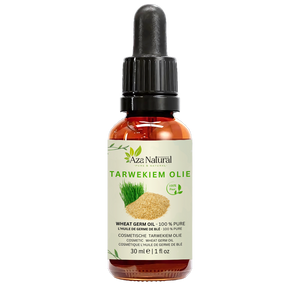
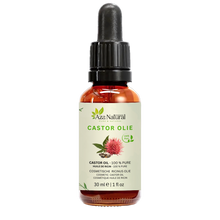
Wheat germ oil is the plant oil from the germ of the wheat kernel, Triticum vulgare: the small part of the grain from which a new plant would grow. The germ is separated when wheat is milled into flour and is pressed on its own; a great deal of grain gives a little oil, which explains the price per millilitre. On the label of our bottle the ingredient line is printed as Triticum vulgare (Wheat) Germ Oi, the last letter lost at the edge of the print; the INCI name is Triticum Vulgare (Wheat) Germ Oil, and there is no second ingredient.
Many people arrive here after searching for 'wheat germ oil benefits'. This article is about something narrower: what the oil is, what the label says, how it looks, smells and feels, and how to use it. About what the oil does in or under the skin, or in the body, we make no claim. The label states no figures for any component and there is no analysis of this batch, so this text contains none either, and the oil we sell is a cosmetic oil for external use, not a food or a supplement.
Wheat germ oil in brief
- Ingredient: Triticum Vulgare (Wheat) Germ Oil, the only ingredient; printed on the label as Triticum vulgare (Wheat) Germ Oi.
- Plant: wheat, Triticum vulgare; the oil comes from the germ of the kernel, not from the bran or the flour.
- Colour and scent: golden brown; a pronounced grain scent, like a bakery, that stays recognisable in a mixture.
- Texture: thick and viscous; too heavy for most people as a daily face oil on its own.
- Use: a small share of a face oil, balm or cream of your own, pure on small dry patches, and in a hair mask; external use only.
- Gluten: the product carries no gluten statement; anyone who does not tolerate gluten asks us before using it.
- Sizes: 30 ml and 100 ml in dark glass, singly or in packs of three or six.
- Storage: cool, dark and closed; buy the small bottle and finish it.
Where does wheat germ oil come from?
A wheat kernel has three parts: the bran on the outside, the starchy body that becomes flour, and the germ, the small embryo at one end from which the plant would sprout. When wheat is milled into white flour, bran and germ are sifted out, and the germ can then be pressed for its oil. Because the germ is only a small part of the kernel and holds only part of its weight as oil, it takes a lot of wheat to fill one bottle. That is the whole explanation for the price: not a rare plant, but a small part of a common one. Where the wheat for our bottle was grown, the label does not say.
What does wheat germ oil look, smell and feel like?
The oil is golden brown and noticeably thick: it pours slowly, drips reluctantly from a pipette and feels heavy on the skin. It sinks in slowly and leaves a film that stays for a while, which is why most people use it mixed with a thinner oil rather than on its own. The scent is the most distinctive thing about it: a pronounced grain scent, warm and a little like bread, that does not fade quickly and stays recognisable even in a mixture where the oil is only a small share. Whoever wants a scentless face oil chooses something else; whoever likes the scent of grain finds it here.
What do people use wheat germ oil for?
- As a small share of a mixture of their own. One part wheat germ oil to five to ten parts thinner oil in a face oil, balm or cream; more makes the mixture heavy and lets the grain scent take over.
- Pure on small dry patches. A few drops on elbows, heels, hands or cuticles, rubbed in with the fingers.
- In a hair mask. A small amount stirred through a thinner oil, applied to the lengths, left for half an hour and washed out.
How do you use wheat germ oil in a mixture of your own?
This is the most common use. Wheat germ oil goes into a face oil, balm or cream as a small share of the oil phase: one part wheat germ oil to five to ten parts other oil. For a 30 ml pipette bottle that means 3 to 6 ml of wheat germ oil topped up with a thinner oil such as jojoba oil or sweet almond oil. More than that makes the mixture heavy and lets the grain scent dominate. Because the oil is thick, measure it with a small spoon or a scale rather than counting drops; a teaspoon is about 5 ml. Make small amounts, keep them cool and dark, and use them within a few months. If you add an essential oil, keep it to one drop per 30 ml and do the wrist test first.
How do you use wheat germ oil on dry patches?
Pure, wheat germ oil is at its best on small areas where a thick oil is welcome: elbows, knees, heels, the backs of the hands and the cuticles. Put two or three drops on the fingertips, rub them warm and work the oil into the patch, preferably after showering while the skin is still slightly damp. As a daily oil for the whole face it is too heavy for most people; if you want it on the face, mix it as described above and use two drops of that mixture in the evening. Before the first use, put one drop on the inside of your wrist or elbow and wait a day.
How do you use wheat germ oil in hair?
Pure on the scalp the oil is usually too heavy and hard to wash out. For a hair mask, stir a teaspoon of wheat germ oil through two tablespoons of a thinner oil, warm the mixture between the hands and work it through the lengths and ends of dry hair, staying away from the roots. Put the hair up under a towel or shower cap, leave it for half an hour and wash it out with a mild shampoo; lather on the dry hair first and add water afterwards, and expect to shampoo twice. Once a week is enough. On the ends alone, one drop of the mixture, not of the pure oil, is plenty.
Wheat germ oil and gluten
Gluten is a protein of the wheat kernel, and this product carries no gluten statement: the label names the oil and nothing else, and there is no analysis certificate that says how much protein, if any, is left in a pressed germ oil. We cannot say on the basis of this product whether it suits someone who does not tolerate gluten or has a wheat allergy. Anyone in that position asks us before using the oil, or leaves it and chooses an oil from a plant they know they tolerate; the pure oils section has many.
How much do you use, and which size?
Because wheat germ oil is used as a small share of a mixture, a little goes a long way: a 30 ml bottle is enough for five to ten bottles of face oil, or for months of dry patches at a few drops a time. Thick oils also start to smell old sooner than thin ones, so buy the bottle you will finish rather than the one that is cheaper per millilitre. For most people that is 30 ml. The 100 ml bottle is for anyone who makes creams and balms in quantity. Both bottles hold the same oil.
How should wheat germ oil be stored?
Cool, dark and closed, in the dark glass it comes in, and preferably not in the bathroom or on a windowsill. The label states no period after opening; our advice is to finish an opened bottle within a year, and sooner if you can. In a cold room the oil becomes even thicker; let the bottle stand at room temperature for a few minutes before pouring. If the grain scent turns sharp, musty or like old paint, the oil has gone off and should not be used any more.
What to keep in mind
Wheat germ oil is for external use only. It is a cosmetic oil, so it is not for the kitchen and not meant to be swallowed; whoever wants wheat germ oil for food buys a product labelled and sold as food. Do the wrist test before the first use, and ask us first if you do not tolerate gluten or wheat. Avoid contact with the eyes and rinse with lukewarm water if it happens. Keep out of reach of children. The label names no fragrance components; an analysis certificate of this batch is not available, so we say nothing further about that.
Where does Aza Natural's wheat germ oil come from?
We sell wheat germ oil pure, with Triticum Vulgare (Wheat) Germ Oil as the only ingredient on the label, in 30 ml and 100 ml bottles of dark glass. If you have never used it, start with 30 ml and a mixture. Another thick oil that is mostly used mixed is castor oil, and a thin oil to mix either of them with is jojoba oil.