
In dit artikel
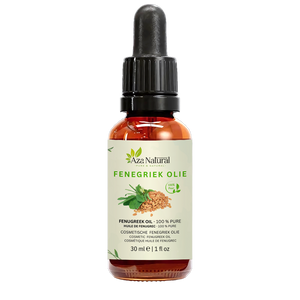
Fenugreek oil is the cold-pressed plant oil from the seed of fenugreek, Trigonella foenum-graecum, an annual legume of the pea family that has been grown from the Mediterranean to India for thousands of years. On the label of our fenugreek oil the ingredient reads Trigonella Foenum-Graecum (Fenugreek) Seed Oil, cold-pressed and made in India, as a cosmetic oil for hair and skin; there is no second ingredient, so this is the seed oil itself and not a few drops of it in a carrier. It is yellow to amber, with a strong, warm, spicy smell, and comes in a 30 ml and a 100 ml bottle with a pipette.
Many people search for 'fenugreek oil benefits' or search for 'fenugreek oil for hair'. We make no claim about what this oil does to the hair, on the scalp, in the skin or in the body: the label says nothing about that, and neither do we. Fenugreek is also a kitchen spice and the subject of many stories; this bottle is a cosmetic oil for hair and skin and nothing else, and this page says nothing about fenugreek as something to eat. What you can check yourself is what the label says, why the oil smells the way it does, how it feels, and how to use it. That is what this guide is about.
Fenugreek oil at a glance
- Label: Trigonella Foenum-Graecum (Fenugreek) Seed Oil, the only ingredient, so no carrier oil; cold-pressed; made in India.
- Plant: fenugreek, Trigonella foenum-graecum, a legume of the pea family; the oil comes from the seed, called methi in India.
- Colour and smell: yellow to amber; strong, warm and spicy, like curry and maple syrup.
- Texture: liquid; absorbs at an unhurried pace.
- Use: hair mask, scalp, lengths and ends, home-made hair oil, and a few drops in a neutral oil for the skin; external use only.
- Patch test: fenugreek is a legume, related to peanut, soy and lupin; anyone who reacts to those does the wrist test first.
- Bottle and storage: 30 ml or 100 ml, dark glass with pipette; cool, dark and closed, finish within a year.
The seed and its smell
Fenugreek seeds are small, hard, angular and yellow-brown, and they hold very little oil; what comes out under a cold press is the oil in this bottle. The name foenum-graecum is Latin for Greek hay. The smell is the first thing you notice and the thing people ask about: strong, warm and spicy, somewhere between curry and maple syrup. It comes from sotolon, a compound in the seed that is also what makes fenugreek smell the way it does in a curry, and it carries into the oil. On the hair, the smell stays until you wash; on the skin, it lingers for hours. That is why the oil is used mainly on hair, where it is washed out, and diluted on the skin.
How the oil looks and feels
Yellow to amber and clear. It is liquid, neither thin like jojoba oil nor thick like castor oil, and it absorbs at an unhurried pace, which suits a mask that is meant to sit for a while. On light hair it does not tint. On the hands it leaves the smell longer than the feel.
As a hair mask
This is the use most bottles are bought for. A tablespoon of fenugreek oil, about 15 ml, worked over the scalp and through the lengths of dry hair, left for thirty to sixty minutes under a towel, then washed twice: the first shampoo on barely wet hair, the second as usual. Once a week. A tablespoon is a lot of a strong-smelling oil; if the smell is too much, halve it and mix the rest with a neutral oil.
On the scalp
A teaspoon massaged into a dry scalp with the fingertips, parting by parting, an hour before washing, then two shampoos. Once a week. If your scalp gets greasy quickly, use it on the lengths instead and leave the scalp out.
In a home-made hair oil
One part fenugreek oil to three to nine parts castor oil or jojoba oil, so that the smell comes along without taking over the blend. With castor oil you get a thick oil for the scalp and the ends; with jojoba, a light one for the lengths. Mix in a clean dark glass bottle, label it, and a 30 ml bottle of the blend lasts months at a few drops a time. Other oils to blend with are in the carrier oils collection.
On the skin, diluted
A few drops through a neutral oil or a body lotion for dry patches on the body and hands. Neat on the face we do not recommend it, because of the smell, not because of anything else; a drop in a teaspoon of sweet almond oil is as far as most people go.
How much you use and which bottle to choose
Hair mask: once a week, a tablespoon of about 15 ml. A 100 ml bottle gives six to seven masks, a good six weeks at weekly use; a 30 ml bottle gives two. Scalp only: a teaspoon of about 5 ml, so six applications from 30 ml and twenty from 100 ml. Home-made hair oil: one part to three to nine, so a 30 ml bottle of fenugreek oil lasts months. Skin: a few drops a time through another oil. Anyone who buys the oil for masks chooses 100 ml; anyone who wants to try the smell first, or blends it, chooses 30 ml. Both bottles hold the same oil, in dark glass with a pipette. More oil does not give a better mask, only a longer wash.
How to store it
Cool, dark and tightly closed, not in the bathroom, and finish an opened bottle within a year; the label gives no shelf life and we give none either. If the oil smells sharp or rancid instead of warm and spicy, do not use it any more. Because the smell is strong to begin with, go by the change rather than the strength.
What to watch out for
External use only: this is a cosmetic oil, so do not swallow it and do not use it in the kitchen, even though fenugreek seed is a well-known spice. Fenugreek is a legume, related to peanut, soy and lupin: anyone who reacts to peanut or other legumes does the wrist test first and asks a doctor when in doubt. Apply one drop to the inside of the wrist first and wait a day. Avoid contact with the eyes and rinse with lukewarm water. Keep out of reach of children. The smell can be smelt on the pillow the next morning; wash the mask out before bed, or use an old pillowcase.
Frequently asked questions
Why does fenugreek oil smell of curry?
Because of sotolon, a compound in the seed that gives fenugreek its smell in the kitchen too, and that carries into the pressed oil.
Is this pure seed oil or a few drops in a carrier?
The seed oil itself: the label names one ingredient, Trigonella Foenum-Graecum (Fenugreek) Seed Oil, and no carrier.
How long do I leave the mask on?
Thirty to sixty minutes under a towel, then two shampoos.
Can I use it on the face?
Diluted, a drop in a teaspoon of a neutral oil. Neat we do not recommend it, because of the smell.