
In dit artikel
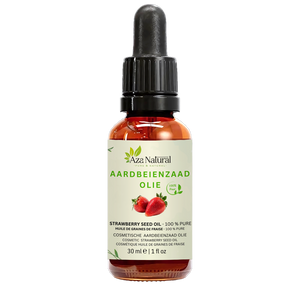
Strawberry seed oil is the cold-pressed plant oil from the seeds of the strawberry, the fruit of Fragaria ananassa, the garden strawberry, a plant of the rose family grown all over the world. On the label of our strawberry seed oil the ingredient reads Fragaria Ananassa Seed Oil, cold-pressed and made in India, as a cosmetic oil for hair and skin; there is no second ingredient. It is a light yellow, very thin oil, sold in a 30 ml and a 100 ml bottle with a pipette.
Many people search for 'strawberry seed oil' or search for 'strawberry oil for skin and hair'; the address of this page still carries a Norwegian word for seed oil, from the machine translation that stood here before. We make no claim about what this oil does in or under the skin or to the hair, and it is not a sunscreen: the label says nothing about any of that, and neither do we. What you can check yourself is what the label says, how the oil feels and smells, why it should be kept cool, and how to use it, in what amount. That is what this guide is about.
Strawberry seed oil at a glance
- Label: Fragaria Ananassa Seed Oil, the only ingredient; cold-pressed; made in India.
- Plant: the garden strawberry, Fragaria ananassa, of the rose family; the oil comes from the seeds on the outside of the fruit, not from the red flesh.
- Colour and smell: light yellow; a faint, slightly fruity smell that does not smell of strawberry and is gone after a few minutes.
- Texture: very thin; absorbs fast and leaves no greasy layer, one of the lightest oils in the shop.
- Keeping: a highly unsaturated seed oil, so it ages sooner than a butter; cool and dark, finish within a year.
- Use: face, also in the daytime under make-up; hands and cuticles; hair ends; a light part of a blend; external use only.
- Allergy: strawberry is not on the European list of fourteen allergens, but a strawberry allergy is common; anyone who reacts to strawberry tests first.
- Bottle: 30 ml or 100 ml in dark glass with a pipette.
Where the seeds come from
The small yellow dots on the outside of a strawberry are the seeds; botanically each dot is a tiny fruit with the seed inside, and the red flesh around them is the swollen base of the flower. Strawberries are mostly eaten fresh and otherwise pressed to juice, puree and jam, and in that processing the seeds come free; that is as a rule the raw material for strawberry seed oil, because from one strawberry with a few hundred seeds of less than a milligram each you get no oil, and from a heap of seed from a juice plant you do.
Many seeds go into little oil, which is why this oil costs more per bottle than an oil from a large kernel or nut. The label says made in India; where the strawberries were grown, it does not say, and so neither do we.
Why it does not smell of strawberry
This is the question asked most often about strawberry seed oil, and the answer is no. The smell of a strawberry sits in the ripe fruit, and the oil comes from the seed; what remains is a faint, slightly fruity smell that most people find neutral and that is gone from the skin after a few minutes. For most buyers that is an advantage: the oil goes under a day cream or make-up and into a blend without changing the smell of anything. Anyone looking for a product that smells of strawberry is looking for something other than this oil, and we add no fragrance to it: the label names one ingredient and no perfume.
How it feels, and why it should be kept cool
Three things about strawberry seed oil follow from the fact that it is pressed from a very small, oil-rich seed. First the feel: highly unsaturated oils are thin and absorb fast, and this oil is the clearest example of that in our range; after a few minutes the skin does not feel greasy and no film is left, which is why it is bought for the face and for the daytime. Second the smell, which is faint and fades.
Third the keeping: highly unsaturated oils react faster with air, light and warmth than a saturated oil or a butter; a bottle left open in a warm bathroom starts to smell sharp or musty, and then it is finished. That is why the oil is in dark glass and why we say to finish an opened bottle within a year; the label gives no shelf life.
On the face
Two to three drops on lightly damp skin after cleansing, pressed in with the flat of the hand rather than rubbed; after a few minutes the oil has absorbed and no greasy layer remains. If you use a day cream, apply the oil first and the cream after, or mix two drops into the portion of cream in your hand; because the oil is so light it suits the daytime and make-up, and that is the reason many people choose this oil for the morning. The faint smell is there for the first minutes and then gone. The first time, use one drop along the jawline and look at the skin the next day; anyone who reacts to strawberry does the wrist test first. Other oils for the face are in the face oils collection.
On the hands and the hair ends
On the hands, one or two drops after washing them, rubbed over the backs of the hands and into the cuticles; the oil absorbs so fast that you can touch a keyboard or a door handle straight away. On the hair ends, one drop, rubbed between the palms and smoothed over the last centimetres of dry hair, not on the roots; because the oil is so thin it disappears into the hair without weighing it down, so one drop is enough even for long hair. As an oil for a hair mask it is too thin and too costly; take a fuller oil for that. On the body it works too, half a teaspoon per arm or leg after showering, but for large areas a cheaper oil is more practical.
In a home-made blend
In a blend, strawberry seed oil is the light part: one part strawberry seed oil to two or three parts of another oil or melted butter gives a face oil, serum or balm that absorbs faster than the heavier oil alone, and because the oil has so little smell, it does not change the smell of the blend. Anyone who wants one oil for everything mixes it with jojoba oil, which is scentless and by far the longest-keeping; one part strawberry seed oil to two parts jojoba is a light face oil without a smell of its own.
Because strawberry seed oil ages sooner than most other oils, it sets the shelf life of the blend: mix a small amount at a time in a clean jar, keep it cool and dark and use it within a few months.
Strawberry, raspberry and blackberry seed oil: three from the rose family
The strawberry is related to the raspberry and the blackberry: all three belong to the rose family, and from all three we press the oil from the seeds. The difference sits in the genus: raspberry and blackberry are Rubus species with the seeds inside the fruit, the strawberry is a Fragaria with the seeds on the fruit. Raspberry seed oil and blackberry seed oil are, like this one, thin and faint in smell and used in the same way; strawberry seed oil is the thinnest and the lightest in colour of the three. Anyone choosing between them chooses on smell, colour and price, not on an effect, because we claim none for any of the three.
How much you use and which bottle to choose
Face: two to three drops a time, once a day; three drops is about 0.15 ml, so a 30 ml bottle lasts two hundred applications, more than six months. Hands: one or two drops a time, about 0.1 ml, so three hundred times from 30 ml. Hair ends: one drop on wash days, and you hardly notice that on the bottle. A blend: a teaspoon of 5 ml strawberry seed oil to two or three teaspoons of another oil gives 15 to 20 ml of face oil. More oil does not give a better result, only skin that shines longer; with this very thin oil less is nearly always enough.
For the face, the hands or the hair ends, 30 ml is enough for months and the bottle is empty before the oil is old; with an oil that ages as fast as this one, that is the main argument, and for most people 30 ml is the right size. For the body or as the regular light oil in blends, 100 ml is cheaper per millilitre; keep the big bottle cool and dark and finish it within a year. Both bottles hold the same oil, in dark glass with a pipette.
What to watch out for
External use only: this is a cosmetic oil, so do not swallow it and do not use it in the kitchen, even though the strawberry itself is a fruit. It is not a sunscreen and replaces none. Apply one drop to the inside of the wrist first and wait a day.
Strawberry is not on the European list of fourteen allergens, but a strawberry allergy is a well-known food allergy; whether the oil from the seeds contains the same substances as the fruit we do not know, because there is no analysis certificate of this batch, and the label names no fragrance. Anyone who reacts to strawberry does the wrist test in any case or asks a doctor; if you react, stop. Avoid contact with the eyes. Keep out of reach of children.
How to store it
Cool, dark and tightly closed, preferably not in the bathroom; if the oil smells sharp, musty or rancid instead of faint and fruity, do not use it any more. Other single-ingredient oils are in the pure oils collection.
Frequently asked questions
Does strawberry seed oil smell of strawberry?
No. The smell sits in the fruit; the oil from the seed smells faint and slightly fruity, and that is gone after a few minutes.
Can I use it under make-up?
Yes. It is one of the thinnest oils in the shop and leaves no greasy layer; that is what most people buy it for.
Why should it be kept cool?
Because it is a highly unsaturated seed oil, which ages sooner than a butter or a wax. Dark glass, a cool cupboard, and finish it within a year.
Can I use it with a strawberry allergy?
Test first on the wrist or ask a doctor; we cannot say without an analysis whether the oil carries the same substances as the fruit.